Watch Me Build A Marketing Funnel
As web designers, we’re constantly looking for ways to deliver more value to our clients while building sustainable revenue for our agencies. One of the most effective approaches I’ve discovered is creating what I call “outcome journeys” - complete marketing funnels that generate predictable results for our clients.
Let’s dive into a behind-the-scenes look at how to build these funnels, which can easily command $1,000+ per month in recurring revenue. I’ll share everything from defining the client persona to selecting traffic sources, and even the exact tools I use to implement these systems.
Why Traditional Web Design Services Aren’t Enough Anymore
The days of selling isolated services like websites, ads, or SEO are behind us. Instead of offering these services separately, we’re seeing much better results by linking them together into comprehensive outcome journeys. These connected systems not only deliver better results for our clients but also command higher rates for our agencies.
What Makes a Marketing Campaign Actually Convert?
Before diving into the technical details, let’s look at what separates high-converting campaigns from those that fall flat. The key is focusing on one specific outcome.
We are NOT promoting:
- An entire business
- A collection of services
- Multiple products
- Vague promises of success
For example, rather than promoting “web design services” or promising to “transform your online presence,” we want to focus on specific, measurable outcomes that resonate with our target audience.
The Five-Step Framework for Building Campaigns That Convert
Here’s the framework we’ll use to create our marketing funnel:
- Define a specific persona interested in the outcome
- Select one primary traffic source
- Create a landing page with a compelling lead magnet
- Develop a lead nurturing sequence
- Implement clear conversion steps
Let’s break down each component in detail.
Defining Your Client Persona: The Foundation of Success
When building out your client persona, consider these key elements:
- Demographics (age, gender, location)
- Motivating factors driving their interest
- Specific problems or goals they’re trying to solve
- Previous attempts and failures
- Internal and external limiting beliefs
- Alternative solutions they might be considering
- Knowledge gaps and blocking questions
These elements become our North Star, guiding everything from ad copy to email sequences.
Choosing Your Traffic Engine
While it’s tempting to use multiple traffic sources, focusing on one primary source for each outcome journey delivers better results. Common options include:
- Search intent ads (Google Ads)
- Interruptive ads (Facebook, Instagram)
- Organic search content (SEO)
For this example, we’ll focus on search intent ads, as they often provide the quickest path to converting customers.
Creating Converting Landing Pages
Your landing page should include these key elements:
- A headline that matches your ad copy
- Audience qualification content
- Your unique “secret sauce”
- Clear relevance to the target outcome
- Compelling call to action
The key is maintaining continuity between your ad copy and landing page content while addressing the specific concerns of your target persona.
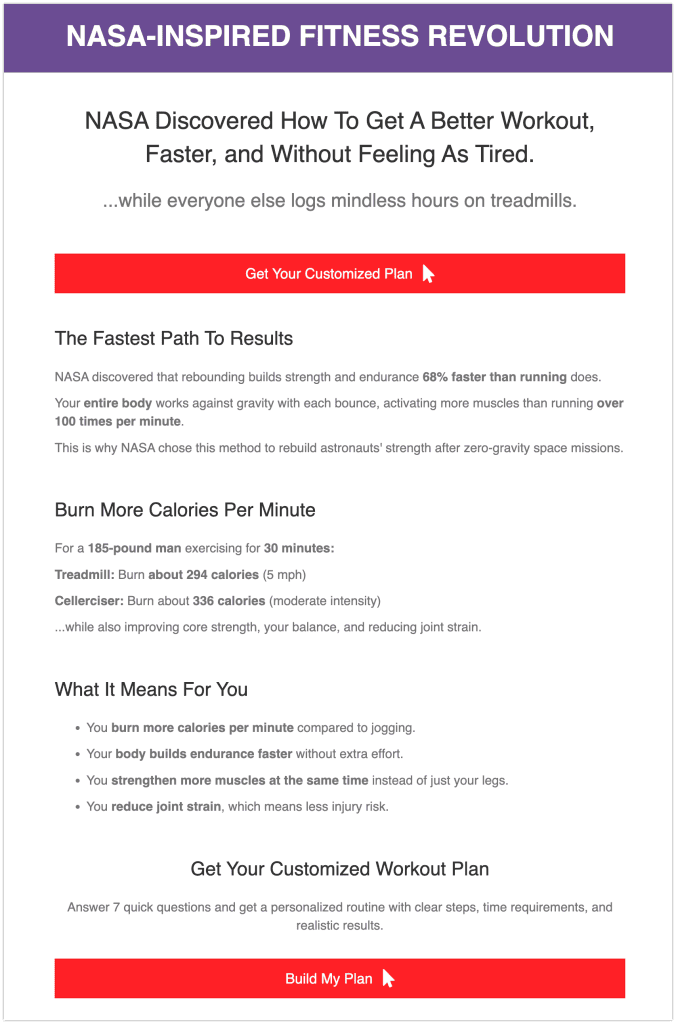
Here’s an example of the copy for each of these sections of the landing page.
Lead Nurturing: The Email Sequence
Once you’ve captured a lead, your email sequence should systematically address:
- Common concerns and limiting beliefs
- Frequently asked questions
- Alternative solutions
- Potential blockers
- Social proof and case studies
The goal is to educate and inspire while pre-qualifying leads before they reach out for your services.
Here are some examples of emails that I would write for this nurturing campaign:
- Why a 10-minute Cellerciser workout improves blood sugar balance
- Why Cellercising balances blood sugar faster than jogging
- Real-world examples of men reversing type 2 diabetes
- Why the Cellerciser is more effective than bungee-based rebounders
- How to use and maintain a Cellerciser (far easier than a treadmill)
- Why dietary changes might not be enough to improve type 2 diabetes
- Why NASA endorses rebounding over walking or jogging
Call To Action
These emails would push people towards an online purchase. Or, if the client still had questions, we would provide a channel for real-time (human) support - either a phone call or an online chat (or both).
Essential Tools for Implementation
Here are the specific tools I use to build these marketing funnels:
Website Platform and Page Building:
- WordPress
- Beaver Builder (primary choice)
- Kadence (alternative option)
- ABSplitTest for headline testing
- Kadence Insights (for AB Testing with Kadence)
Hosting and Infrastructure:
- SiteGround (GoGeek plan)
- Google Analytics
- Clicky for real-time analytics
Email and Lead Generation:
- Kit (primary choice)
- MailerLite (budget-friendly alternative)
- Gravity Forms for lead magnets
- Lead Quizzes (alternative option)
Business Operations:
- Calendly for scheduling
- SureCart for e-commerce
- Google Workspace or Fastmail for business email
Moving Forward With Your Own Outcome Journeys
By implementing this framework, we’re able to create marketing systems that consistently deliver results for our clients while generating predictable monthly revenue for our agencies. The key is focusing on specific outcomes and building comprehensive journeys rather than selling isolated services.
This approach isn’t about limiting your client’s services - it’s about creating targeted marketing campaigns that resonate with specific audience segments. You can run multiple campaigns simultaneously, each targeting different outcomes and audience segments.